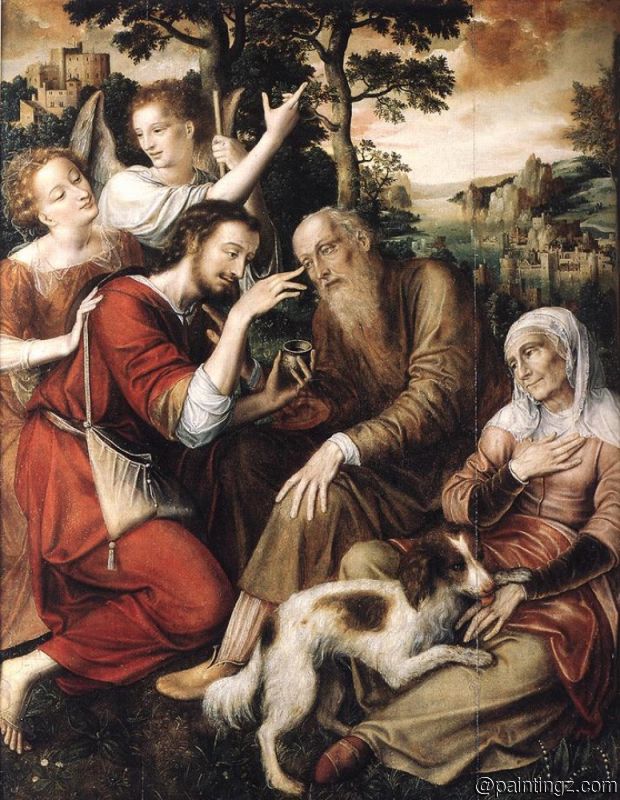
The book of Tobit, among the Old Testament Readables, instructs us even by means of its title, which is taken from the name of the father in the story. Tobit means “my good,” and his name is expanded in the name of Tobias, his son, which means “God is my good.” Throughout this engaging story, the goodness, providence, and generosity of the LORD are celebrated both on a micro and a macro level. Tobit, an old man who has become poor through social oppression in the Assyrian exile from the holy land, as well as blind through an accident of nature, sends his only son Tobias on family business, but also to seek a wife from the family line. Accompanied by the family dog, and the archangel Raphael (who appears as a young man called Azariah), Tobias travels from Ninevah to Ecbatana, escaping a voracious fish during the trip, and saving its innards, as instructed by the angel. He is led to Sarah, rescues her from a demonic curse in which all her previous suitors have been killed on their wedding nights, and brings her home in joy to his parents—along with the riches he was sent to procure, and blessed with a cure for his father’s blindness. Both the exorcism of the nuptial demon and the healing of Tobit are accomplished by the application of the fish innards, as prescribed by Raphael. The happy domestic outcome of the story is enhanced by the interpretation of the angel Raphael, and interlaced with promises that God will restore His people and even call the Gentiles out of darkness to worship Him. These theological truths are combined with the piety and success of Tobias, who reminds us of Another sent by his Father to seek a Bride, who brought about great rejoicing for all humanity.
Throughout the story, we see the interplay between tragedy and blessedness, help and opposition, fear and confidence in God. We also see God’s concern for every level of human existence— our mysterious connection with usually unseen angels and demons, our enmeshment in the political world, our link with those around us in society, our deep relationship within the family and within marriage, and even our interconnection with the natural world of fish, dogs, birds, and crops. The story has a folk quality, yet it makes more than a nod to historical vicissitudes and to practical details of everyday life. It is also written with great subtlety, including shrewd characterization of the six major characters, high moments of drama, and also moments of wry humor where the author reminds us that as readers we know more than the players in the story.
For this episode, let’s focus upon the characters in the story, leaving the beautiful poetry, theological insights, and careful teaching for later. During our episodes, I will not read to you the whole story of twelve chapters, but recommend highly that you read it in entirety after this episode (or even now, if you want to stop reading the blog or listening to the podcast for a moment). There are superhuman characters, human characters—both male and female—and animals, who drive the story, and bring it to a conclusion.
The supernatural actors in the story include God Himself, who is praised and blessed throughout by the main characters, and who hears their prayers, the mysterious but revelatory angel Raphael, and the unseen but reported demon, Asmodeus. Raphael is one of the archangels, whose name means “God has healed” or “restored”—an apt figure to accompany Tobias on his quest of the beset maiden Sarah, and to instruct him regarding how to bring healing to his ailing father. On the human level, he is known as Azariah, which means “the Lord is my helper,” and subtly reminds us that though Tobias does not know the identity of Raphael, a close attendant of God, he experiences him as a human helper. Throughout the story, Raphael gives encouragement to Tobias, advice in pursuing the hand of the maiden who is designated for him, instruction on how to use parts of a strange fish in order to quench evil and heal, practical help in completing the financial task set by the father of the family, and revelatory wisdom at the end in which he both explains his mysterious identity, and the plans of God for Tobit’s family and for the world. When he is first introduced by Tobias to the father Tobit, he styles himself as Tobit’s “kin”—this may not be literally true, but it underscores the fact that both angels and humans are created by God, and thus part of the same rational family, and that righteous human beings, like the angels, are close to God. Ironically, though Tobit does not know Raphael’s true identity, he prays “may God’s angel accompany you,” and comforts his fearful wife, Anna, that “a good angel will accompany him.” Later we hear that one of the major roles of Raphael, who stands with the other six angels before God, is to bring prayers of the faithful before God—and so it is God who takes center stage even when Raphael is acting. The blessed Augustine, warning us against exaggerated veneration of angels, says that it is only a demon who would want to “block your way” to God or “intrud[e] ihimself with evil intent…. I mean, that angel in the Apocalypse and others like him do not want themselves, but God, to be adored (Newly Discovered Sermons 198.48 WSA 3/11:217). Raphael’s greatest “aid” then, is to encourage the quester, Tobias, to trust in God. So it is that Raphael speaks to Tobias of his future wife, saying, “Do not be afraid; she was set apart for you before the world was made.”
Of the demon Asmodeus we know less. Various explanations are given for his identity, but he is clearly a powerful enemy, sometimes associated with Apollyon, whose name means “Destroyer.” Others find an etymology that means “demon of anger,” or link him with lust: both associations fit with the story that Tobias’ future wife has lost seven potential husbands on her wedding night! It is instructive that the book does not dwell on Asmodeus’ power or rank, but simply tells the story of how he is deterred from doing evil by the incense mingled with fish innards prescribed by Raphael, so that he flees to a remote part of Egypt, where he is bound hand and foot by Raphael. The strong man so bound cannot harm God’s chosen son and daughter, nor their family. His curse is broken, and Sarah is freed to marry the one for whom she is intended.
The patriach in the narrative, Tobit, is described as pious even to the point of risking his life. His generous three-fold tithing while in the Holy Land is transferred into an unprecedented liberality among the exiles, and at first he enjoys a good standing with the king. However, his piety in burying the Jewish enemies of Sennaracherib leads to his downfall, as all his goods are confiscated, until his fortunes turn again at the death of the king. During Pentecost, he hears of the murder and desecration of a Jewish person, and buries him at sunset, only to wake, after sleeping outside, to find himself blind because of bird droppings that have infected his eyes. Yet he remains a wise father, as the blessed Augustine remarks: “Tobit was blind yet he taught his son the way of God” (Exposition of the Psalms 96:18; NBA 27.1: 397). He is, though, not perfect, and wrongly accuses his wife Anna of theft, when her employer has given her a goat as part of her wages. In his interaction with her, he appears like a weaker version of Job, an apt representative of the Jewish people, crying out in their exile, and even longing for death. Despite his world-weariness, his piety remains, and he admonishes Tobias his son to be mindful of his mother, “because she faced many dangers for you when you were in her womb.” Later he comforts her, both before Tobias leaves, and also when their son is delayed, calling her “my sister,” and “my dear.” With all his flaws, the words of St. Cyprian of Carthage ring true:
Be to your children such a father as was Tobias. Give useful and salutary precepts to your pledges such as he gave to his son; command your children as he too commanded saying, “And now, sons, I command you, serve God in truth, and do before God what pleases him; and command your children that they do justice and almsdeeds and that they be mindful of God and bless God’s name on every occasion” (Works and Almsgiving 20. FC 36.246).
It is interesting that the female characters are not only named but also well-rounded and believable. Anna takes up the slack when her husband is not able, shows the characteristic concern of a mother for her only son, and heeds her husband’s comforting words. She rushes out to watch the road for days when he is overdue, looking for her son, whom she calls “the light of my eyes.” She is as important in Tobias’ world as the father is, and becomes his eyes, watching for the son, when Tobit can not.
Edna, the mother of Sarah, also plays an important role, and is called “sister” by her husband Raguel. She is the one who discovers the kinship between the two families, and shows emotion to hear that her kinsman Tobit is still alive in Ninevah. She it is who brings to her husband the writing material for the wedding contract. Edna also makes the bridal chamber ready and ushers in her daughter, even despite the demonic curse, admonishing her to “Take courage,” and praying for her. She prepares the banquet of bread and rams for Tobias and Raphael, reminding us of Sarai’s preparations for the three angels at Mamre. Before Tobias returns, she blesses him, telling the couple to “go in peace,” and reminding Tobias that he now has another mother, herself. Her name, Edna, means “pleasant,” which she is, just as Anna’s name, meaning “favored,” speaks of the blessed outcome for her family.
Finally, there is Raguel, Sarah’s father, whose name means “God is his sustenance” or “God is my friend.” Like his counterpart Tobit, he is full of paternal wisdom, blessing his daughter and new son-in-law before their wedding night, and reminding Tobias, “from now on you are her brother and she is your sister.” As they depart for Ninevah, he bequeathes on Tobias half of his goods, since Sarah is his only child, and, he reminds Sarah that she now has two extra parents whom she should honor.
Of Sarah, Tobias, and their poignant marriage, we will hear in the next episode, now that we have seen the supporting angelic and human cast. But we have still the level of the creation to consider in our story.
We have heard already of one subhuman creature, the menacing fish, who attacks Tobias on the road, but whose heart, liver, and gall, are used to chase away the demon and to heal the blind Tobit. These natural elements give the sense that God uses his creation as well as his angelic messengers for the good of the faithful. This same impression comes to us through the dog, mentioned in most versions at the start of the journey, and still with the travellers as they return home. Evidently, *by this time in Jewish culture, or perhaps exilic Jewish culture, dogs are not simply unclean nuisances. The Venerable Bede remarks, “One must not dismiss with scorn the figure of this dog, which is a traveler and the companion of an angel” (On Tobit BTACH 39. CCL 119B). And St. Ambrose, in speaking of dogs as part of God’s creation, has this to say:
What shall I say about dogs who have a natural instinct to show gratitude and to serve as watchful guardians of their masters’ safety? … To dogs, therefore, is given the ability to bark in defense of their masters and their homes…. [I]f you consider the keenness of their senses, you can well believe that their sagacity of sense perception has taken on the trappings of reason. Hence, one can easily perceive that they are able to understand, by the training given by nature, what it has taken a few individuals a long period of time to achieve with the aid of… argumentation acquired in the advanced schools of rhetoric. What men, with the aid of prolonged discussion and meditation, achieve with difficulty nature readily supplies to dogs. … Who is as mindful of benefits and as grateful for kindness as the dog? For their masters’ sake they go so far as to “leap on robbers and to keep off strangers prowling at night. They are prepared, too, to die in defense of their masters and even to die with them! … Such a dog was the friend and companion of an angel. Not without reason did Raphael in the prophetic book cause this dog to accompany the son of Tobias when he went on a journey, in order to drive out Asmodeus and thereby confirm the marriage. The demon is driven out as the result of a grateful recognition, and the union is stabilized. And so, under the symbolism of a dumb animal, the angel Raphael, as director of the young man Tobias whom he had agreed to protect, was able to arouse sentiments of gratitude in him. (Hexameron 9.4.17. FC 42. 236-7).
Well, then, the natural world, too, with its representative of the dog, speaks to us of God’s goodness. The Latin version probably embroiders the story when, at the end, the dog runs ahead of Tobias’ convoy, barking an announcement of their arrival, and wagging its tale in joy. However, this image sums up, in a whimsical way, the familial blessings celebrated in this story of two only children, brought together in piety, and in love, and their happy extended family. The mother Edna has prayed a hope that reminds us of Dicken’s Tiny Tim: “May we all prosper together all the days of our lives.” The dog, with its faithfulness and gratitude, stresses this human hope, “May God bless us everyone,” and assures us that the Creator of all does not consider such desires to be trivial. These human joys are caught up with ones that we can scarcely imagine, as the nineteenth century poet Pierpoint suggests in his Eucharistic hymn:
For the beauty of the earth,
For the beauty of the skies,
For the Love which from our birth
Over and around us lies:
Christ, our God, to Thee we raise
This our Sacrifice of Praise.For the beauty of each hour
Of the day and of the night,
Hill and vale, and tree and flower,
Sun and moon and stars of light:
Christ, our God, to Thee we raise
This our Sacrifice of Praise.For the joy of ear and eye,
For the heart and brain’s delight,
For the mystic harmony
Linking sense to sound and sight:
Christ, our God, to Thee we raise
This our Sacrifice of Praise.For the joy of human love,
Brother, sister, parent, child,
Friends on earth, and friends above;
For all gentle thoughts and mild:
Christ, our God, to Thee we raise
This our Sacrifice of Praise.For each perfect Gift of Thine
To our race so freely given,
Graces human and Divine,
Flowers of earth, and buds of Heaven:
Christ, our God, to Thee we raise
This our Sacrifice of Praise.For Thy Bride that evermore
Lifteth holy hands above,
Offering up on every shore
This Pure Sacrifice of Love:
Christ, our God, to Thee we raise
This our Sacrifice of Praise.For Thy Martyrs’ crown of light,
For Thy Prophets’ eagle eye,
For Thy bold Confessors’ might,
For the lips of Infancy:
Christ our God to Thee we raise
This our sacrifice of praise!
For Thy Virgins’ robes of snow,
For Thy Maiden Mother mild,
For Thyself, with hearts aglow,
Jesu, Victim undefiled,
Offer we at Thine own Shrine
Thyself, sweet Sacrament Divine.
 Edith M. Humphrey