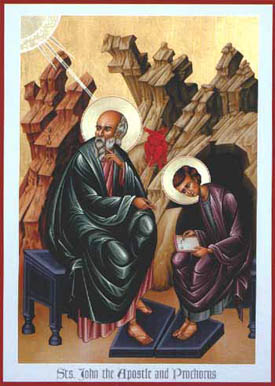
In February, will be teaching the Fourth Gospel again for St. Cyril’s Coptic Seminary in Sydney Australia. I was asked to reflect on the subject and on the course, and thought perhaps my friends would be interested in why I love to teach this book, and what we can learn from it in particular.
Why should an ordinary Orthodox Christian care about the Fourth Gospel?
The gospel of John is absolutely crucial for understanding our relationship to God, and livng the Christian life authentically. It is in this gospel that we hear about the mystery of the Holy Trinity, and how God draws us into that mystery both personally, and in our life together. While the other three gospels relate many episodes in Jesus’ life, the fourth gospel is unique in how it presents only a few, but plumbs the depths of these few episodes in order to show how we can be transformed within, and together, in order to be servants of God. Throughout the gospel, his apostles, as well as other disciples like the Samaritan woman and Mary Magdalene, are engaged by Jesus in deep conversation, and come to see Him for who He really is, as well as to hear their own calling in this world. As we see their transformation, we are led to glimpse a vision of who we may become in Him, because He entered deeply into our world, for our sake. The wonder of the God-Man is displayed for us from the beginning to the end, where we hear: “Jesus did many other things that are not written in this book…But these are written so that you may continue to believe, and have life.”
What is something particularly intriguing about the Fourth Gospel?
Throughout the gospel of John, there are many arresting, beautiful, and challenging scenes that bring us up short, and cause us to think more deeply. Perhaps the most fascinating to me is in the very first verse. Usually it is translated, “In the beginning was the Word, and the Word was with God and the Word was God.” However, if we look at he orignal Greek, a striking picture emerges: “In the beginning was the Word, and the Word was towards God, and what God was the Word was.” From the very first verse we are being given a verbal picture of the mysterious Holy Trinity. It is not simply that the Son, the Word, was WITH God in the beginning—which, of course He was—but that the Two divine Persons face towards each other, in ineffable communion (as they do also with the Holy Spirit, whom we hear about later). From their incomprehensible love and interaction comes every variety of love that we can imagine: God is the divine source of it all. It is the koinonia, the communion of the Three Person in one Godhead that is at, and before, the beginning of everything. The little phrase “The Word was towards God” lets us in on this secret.
What do I find compelling about the Fourth Gospel in general?
I love the way that the Gospel of John is both symbolic in its nature and realistic. We can picture Nicodemus, Andrew, Photini the Samaritan, Thomas, Peter, the beloved Disciple, before us, as they come alive vividly in the stories. Yet their stories are more than surface tales, and lead us in many directions to think more expansively about God, his world, and His church. For example, in the wedding at Cana, we have a true-to-life representation of a mother talking with her son: they need wine! At the same time, the 5 stone wine jars, the turning of water into wine, the very wedding motif, lead us to contemplate the God who became Incarnate to reclaim Humanity, his Bride, and to change our drab life into something we can scarcely imagine. His people in Israel lived by means of the 5 books of Torah, but now, in Christ, they would have a life full to overflowing. Jesus was a guest at a human wedding but at that wedding he performed the first of his signs-signs that God had come among us, and was there to make us brand new.
How, then, do I try to teach this complex and fascinating biblical book? |
In this course, we read the Fourth Gospel together, as well as consider what both ancient and contemporary commentators have seen in it. Though it is frequently called the “spiritual Gospel,” John’s Gospel is also full of physical images, and shows forth their full significance: light, wine, wind, water, bread, blindness, shepherds, sheep. There is hearing, seeing, touching, smelling, tasting, and coming to know the God who has become incarnate for us. We engage in a careful study of this fascinating gospel, probing its backgrounds, narrative techniques, structure, and deep theological concerns. These dynamics teach us more about the Triune God who is at work among us, more about the wonder of the created world, more about the Church, and more about ourselves. John must also be seen in relation and contrast to the other gospels, so that we can appreciate its unique place in the New Testament. Finally, we explore its importance for the formative theology of the early Church, and its abiding power as a “sacramental” gospel, that is, a gospel that displays Christ, and shows how Christ is seen and known in the elements of creation.

